The Water Carrier
| Abbreviation: | Aqr |
| Genitive: | Aquarii |
| Origin: | [antiquity] |
| Fully Visible: | 86°S – 65°N |
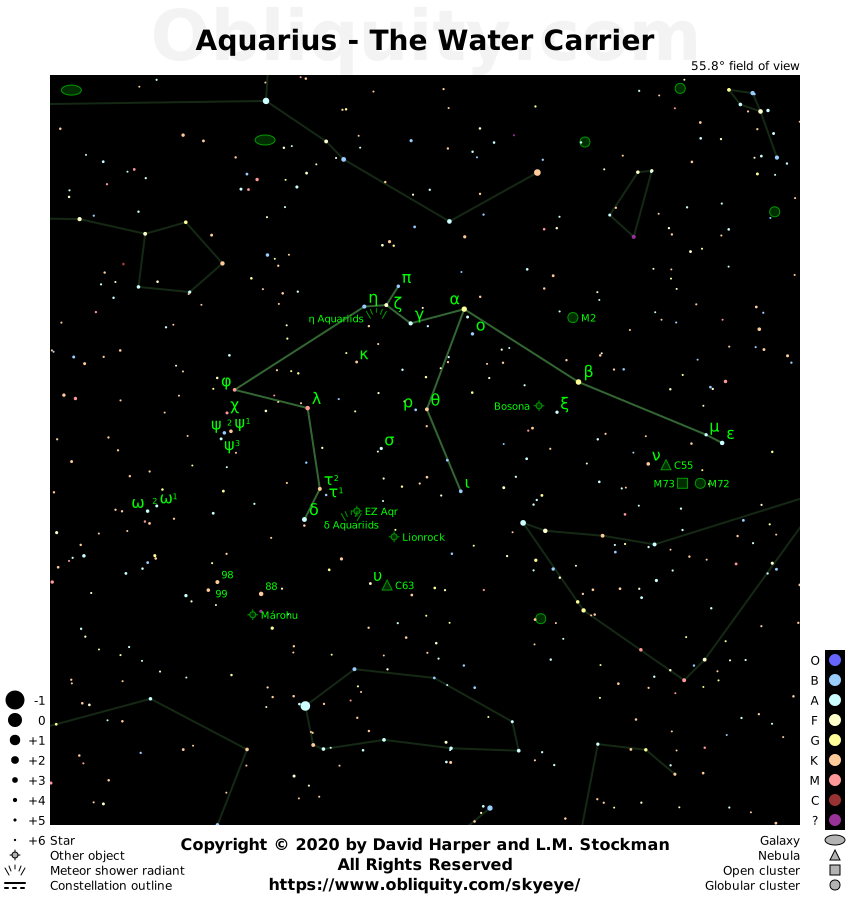
Aquarius is a member of the zodiac. This is one of the most ancient of constellations, harking back to Babylonia and also associated with the annual flooding of the Nile in ancient Egypt. The Greeks considered it to be a water jar pouring water south into the open mouth of Piscis Austrinus, the southern fish. The Y-shaped asterism comprised of γ Aqr, ζ Aqr, η Aqr and π Aqr was sometimes considered a separate constellation called Urna, the water urn. Other old star atlases show the figure of the water carrier holding a nilometer in his left hand. This now-extinct constellation, comprised of the brighter stars running roughly north and south of μ Aqr, was called Norma Nilotica.
Notable Features
| Visible Named Stars | ||
|---|---|---|
| α Aqr | Sadalmelik | The second-brightest star in the constellation is a G-type supergiant. |
| β Aqr | Sadalsuud | Although it has the Bayer designation β, this star is actually the brightest one in the constellation. |
| γ Aqr | Sadachbia | This star appears as Aoul al Achbiya (from the Arabic awwal ul‑akhbiyyah meaning 'the first tent') in Mohammad Al Achsasi Al Mouakket's calendarium. In Hindu astronomy, this star is known as Shatabhisha, from the Sanskrit shatabhishā meaning 'requiring a hundred physicians'. |
| δ Aqr | Skat | This star also appears as Scheat in older star atlases and calendars. This is merely a spelling variant and the name Scheat has since been assigned to β Peg. |
| ε Aqr | Albali | This star appears as Nir Saad Bula (from the Arabic nayyir saʿad al bulaʿ meaning 'the lucky star of the swallower') in Mohammad Al Achsasi Al Mouakket's calendarium. |
| θ Aqr | Ancha | The name of this star should not be confused with Ankaa which has an entirely different meaning and is assigned to α Phe. |
| κ Aqr | Situla | Appropriately for a watery constellation, the name of this star is Latin for 'bucket' or 'water jar'. |
| ξ Aqr | Bunda | This star appears as Thanih Saad al Saaoud (from the Arabic thāniyah saʿad us‑suʿūd meaning 'the second luckiest of the lucky stars') in Mohammad Al Achsasi Al Mouakket's calendarium. The official name comes from a Persian lunar house. |
| 88 Aqr | Safina | This star is named for an Arabic constellation which exists between Aquarius and Piscis Austrinus. Not to be confused with the star Alsephina in the constellation of Vela. |
| Other Interesting Stars | ||
| EZ Aqr | This is one of the closest stars to the Sun. It lies just over 11 light years away and shines at a feeble twelfth magnitude. It appears near the radiant of the δ Aquariid meteor shower on the sky map. | |
| HATS‑72 | Zembra | This twelfth-magnitude star is known to have at least one exoplanet. It is located near υ Aqr. |
| HD 206610 | Bosona | This eighth-magnitude star is known to have at least one exoplanet. It is found near the much brighter star Bunda or ξ Aqr. |
| HD 212771 | Lionrock | This eighth-magnitude star is known to have at least one exoplanet and is located north of C63, the Helix Nebula. |
| WASP‑6 | Márohu | Found just south of Safina (88 Aqr), this twelfth-magnitude star is known to have at least one exoplanet. |
| WASP‑69 | Wouri | This nine-magnitude star is known to have at least one exoplanet and is found in the vicinity of μ Aqr. |
| Deep Sky Objects | ||
| M2 | This globular cluster is easily visible through binoculars. It is one of the largest known globular clusters. | |
| M72 | Another globular cluster, this object is difficult to resolve even through a telescope. | |
| M73 | This is perhaps the most puzzling of the Messier objects, a group of four stars. Once thought to be the remnants of an old open cluster, the stars are actually unrelated and merely form an asterism. | |
| C55 | Saturn Nebula | A telescope reveals this planetary nebula to have a greenish colour. It is located near the star ν Aqr. Its New General Catalogue number is 7009. |
| C63 | Helix Nebula | The bright planetary nebula is one of the closest such objects to Earth. Binoculars or a small telescope are sufficient to reveal its presence. It is also known as NGC 7293. |
| Meteor Shower Radiants | ||
| 005 SDA | Southern δ Aquariids | The meteors in this July-August shower are of medium speed but are mostly faint. The parent comet of this shower is unknown but may be the same one that produced the Quadrantids in Boötes. The radiant is near the star Skat. |
| 031 ETA | η Aquariids | Up to half of these fast, bright meteors leave trains when they flash across the sky in April and May. Associated with the famous comet 1P/Halley, their radiant is near η Aqr. |

 Copyright © 1995–2025 by L.M. Stockman and David Harper