When the creation was new and all the stars shone in their first
splendor, the gods held their assembly in the sky and sang
'Oh, the picture of perfection! the joy unalloyed!'
— Rabindranath Tagore, "When the Creation Was New", 1910
Determining Stellar Distances
It is very difficult to determine the distances to the stars because they are so very far away. The distance to the closest stars can be measured through their parallax. In this technique, the location of a star is painstakingly measured twice, six months apart. (The Earth is on opposite sides of the Sun at the two measurements, providing a long baseline.) If the star is close enough, it will appear to "wobble" slightly compared to the distant stars (which are taken to be fixed in place). The parallax of a star is this tiny angle between the two measurements.
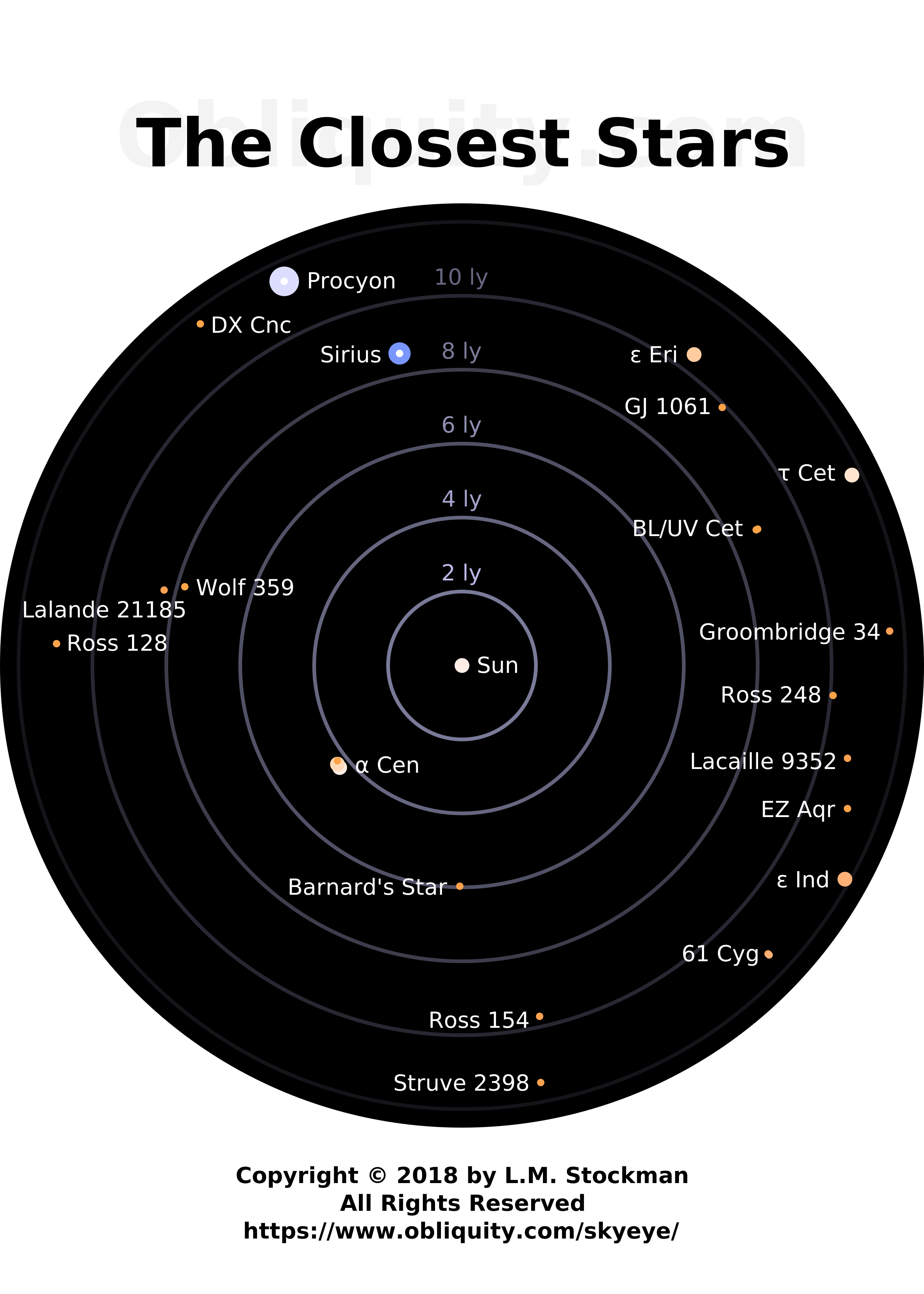
Stars Within 12 Light Years
A number of the closest stars actually form multiple systems. Each component, usually labelled A, B, C, etc., is listed separately. The values for absolute magnitude and distance depend on the accuracy of the observations of the apparent magnitude and parallax. The Sun, which is the closest star to the Earth, is provided for comparison. Note that brown dwarf objects are not included in this list.
| Name or Designation | Spectral Type | Magnitude | Parallax | Distance | |||||
|---|---|---|---|---|---|---|---|---|---|
| Apparent | Absolute | (mas) | (pc) | (ly) | |||||
| Sun | G2Ⅴ | −26.7 | +4.9 | ||||||
| Proxima Centauri | α Cen C | GJ 551 | Cen | M5.5Ⅴe | +11.1 | +15.5 | 768.50 | 1.30 | 4.24 |
| Rigil Kentaurus | α Cen A | GJ 559 A | Cen | G2Ⅴ | +0.0 | +4.4 | 750.81 | 1.33 | 4.34 |
| Toliman | α Cen B | GJ 559 B | Cen | K1Ⅴ | +1.3 | +5.7 | 750.81 | 1.33 | 4.34 |
| Barnard's Star | V2500 Oph | GJ 699 | Oph | M4Ⅴ | +9.5 | +13.2 | 546.98 | 1.83 | 5.96 |
| CN Leo | GJ 406, Wolf 359 | Leo | dM6Ⅴ | +13.5 | +16.6 | 415.18 | 2.41 | 7.86 | |
| GJ 411, Lalande 21185 | UMa | M2+Ⅴ | +7.5 | +10.5 | 392.75 | 2.55 | 8.30 | ||
| Sirius A | α CMa A | CMa | A0mA1Ⅴ | −1.5 | +1.4 | 379.21 | 2.64 | 8.61 | |
| Sirius B | α CMa B | CMa | DA1.9 | +8.4 | +11.3 | 374.49 | 2.67 | 8.71 | |
| UV Cet | GJ 65 B | Cet | M6Ⅴ | +12.8 | +15.7 | 373.84 | 2.68 | 8.72 | |
| BL Cet | GJ 65 A | Cet | M5.5Ⅴ | +12.8 | +15.6 | 367.72 | 2.72 | 8.87 | |
| V1216 Sgr | GJ 729, Ross 154 | Sgr | M3.5Ⅴe | +10.4 | +13.1 | 336.03 | 2.98 | 9.71 | |
| HH And | GJ 905, Ross 248 | And | M5.0Ⅴ | +12.3 | +14.8 | 316.48 | 3.16 | 10.31 | |
| Ran | ε Eri | GJ 114 | Eri | K2Ⅴ | +3.7 | +6.2 | 310.58 | 3.22 | 10.50 |
| GJ 887, Lacaille 9352 | PsA | M2Ⅴ | +7.4 | +9.8 | 304.14 | 3.29 | 10.72 | ||
| FI Vir | GJ 447, Ross 128 | Vir | dM4Ⅴ | +11.2 | +13.5 | 296.31 | 3.37 | 10.99 | |
| EZ Aqr A | GJ 866 A | Aqr | M5Ⅴ | +13.0 | +15.3 | 293.60 | 3.41 | 11.12 | |
| EZ Aqr B | GJ 866 B | Aqr | M? | +13.3 | +15.6 | 293.60 | 3.41 | 11.12 | |
| EZ Aqr C | GJ 866 C | Aqr | M? | +15.1 | +17.4 | 293.60 | 3.41 | 11.12 | |
| 61 Cyg A | Cyg | K5Ⅴ | +5.2 | +7.5 | 285.99 | 3.50 | 11.40 | ||
| 61 Cyg B | Cyg | K7Ⅴ | +6.0 | +8.3 | 286.00 | 3.50 | 11.40 | ||
| Procyon A | α CMi A | GJ 280 A | CMi | F5Ⅳ–Ⅴ | +0.4 | +2.5 | 284.56 | 3.51 | 11.45 |
| Procyon B | α CMi B | GJ 280 B | CMi | DQZ | +10.9 | +13.2 | 284.56 | 3.51 | 11.45 |
| GJ 725 A, Struve 2398 A | Dra | M3Ⅴ | +8.9 | +11.2 | 283.84 | 3.52 | 11.49 | ||
| GJ 725 B, Struve 2398 B | Dra | M3.5Ⅴ | +9.8 | +12.1 | 283.84 | 3.52 | 11.49 | ||
| GQ And | GJ 15 B, Groombridge 34 B | And | M3.5Ⅴ | +11.0 | +13.3 | 280.69 | 3.56 | 11.59 | |
| GX And | GJ 15 A, Groombridge 34 A | And | M2Ⅴ | +8.1 | +10.4 | 280.71 | 3.56 | 11.62 | |
| DX Cnc | GJ 1111 | Cnc | M6.5Ⅴ | +14.8 | +17.0 | 279.25 | 3.58 | 11.68 | |
| ε Ind | GJ 845 | Ind | K5Ⅴ | +4.7 | +6.9 | 274.84 | 3.64 | 11.87 | |
| τ Cet | GJ 71 | Cet | G8Ⅴ | +3.5 | +5.7 | 273.81 | 3.66 | 11.91 | |
| GJ 1061 | Hor | M5.5Ⅴ | +13.1 | +15.2 | 272.16 | 3.67 | 11.98 | ||
Notes
 Proxima Centauri and the two other components of α Centauri form a triple system. Currently, Proxima Centauri is the closest member of this system to the Sun and has one Earth-sized planet orbiting within the habitable zone of the star.
Barnard's Star has the greatest proper motion (apparent angular motion across the sky) of any known star.
Fans of the television series Star Trek will recognize Wolf 359 as the site of the epic battle between Starfleet and the Borg. It is one of the faintest and lowest mass stars yet found.
There have been claims dating back to 1951 of planets orbiting Lalande 21185 but these have never been confirmed.
Sirius B is a white dwarf, a star at the end of its life. An extremely dense object, it is slowly cooling down because it is no longer fusing atoms in its core to produce energy. At the end of its life, the Sun will also become a white dwarf.
UV Ceti is a flare star, undergoing large changes of brightness in very short time frames. Flare stars are sometimes referred to as UV Ceti variables in honour of this remarkable behaviour. Its companion, BL Ceti, is also a flare star but doesn't exhibit such extreme behaviour.
Ross 154 is a UV Ceti variable star.
The Voyager 2 spacecraft is headed roughly in the direction of Ross 248.
In 1998, a dust ring, perhaps similar to the cloud of comets surrounding our own solar system, was discovered around the very young star ε Eridani, now known as Ran. It has one detected planet named Aegir.
Like many red dwarfs, Ross 128 is a flare star.
The closest neighbour of Lacaille 9352 is EZ Aquarii which is actually a triple system of red dwarf stars.
61 Cygni was the first star successfully observed for parallax. Friedrich Wilhelm Bessel (1784–1846) measured the parallax between 1837 and 1840.
Like Sirius B, Procyon B is a white dwarf.
Both elements of Struve 2398 are x-ray sources.
Groombridge 34A and Groombridge 34B form a binary system, orbiting each other in a nearly circular orbit. In 2014 a planet was detected in orbit around GX Andromedae.
The brightness of the flare star DX Cancri can vary fivefold.
In 2003, astronomers announced that ε Indi was accompanied by a brown dwarf. It was later discovered that the brown dwarf was actually a binary system.
τ Ceti features in many science fiction novels by virtue of the fact that it is the nearest single (non-multiple) solar-type star to the Sun. In 2012 it was suggested that the star might contain a system of five planets.
GJ 1061 is so small, it is estimated to be close to the lower mass limit for a star.
Parallax Experiment
You can experience parallax for yourself if you have two functioning eyes. Extend an arm out in front of you and give the "thumbs up" sign. Keeping your arm very still, close your left eye and look at your thumb. Note where it appears relative to the background. Now open your left eye, close your right eye, and do the same thing. Don't move your arm or your head! Your thumb should appear to have moved relative to the background. However, what has actually moved is the observer (your eyes). The distance between your two eyes provides the baseline for this experiment and the angle between the two observations is the parallax. The farther away an object is, the larger the baseline needs to be. This is why the diameter of the Earth's orbit around the Sun is used as the baseline for measuring stellar parallaxes. Even so, this method can only be used for the very nearest stars.

 Copyright © 1995–2025 by L.M. Stockman and David Harper