Oh! ye bright Stars! that on the Ebon fields
Of Heav'n's empire, trembling seems to stand;
'Till rosy morn unlocks her portal bland,
Where the proud Sun his fiery banner wields!
— Mary Darby Robinson, "Sappho's Address to the Stars", 1796
Determining Stellar Brightnesses
The brightness of a star is usually expressed in terms of magnitudes. This scale is based on that devised by the second-century BCE Greek astronomer Hipparchus who labelled the brightest stars as 'first magnitude', the next brightest as 'second magnitude', and so on with the faintest stars visible labelled as 'sixth magnitude'. This scale was placed on a mathematical basis in the nineteenth century when it was shown that a difference of five magnitudes corresponded with a factor of about 100 in brightness. Therefore, the magnitude scale was defined so that a difference of 100 in brightness exactly corresponded to a difference in five magnitudes.
A few stars are actually brighter than first magnitude so the scale was extended to zero and then to negative numbers. The smaller the magnitude is, the brighter the star. Thus, a star of magnitude −1 is brighter than one of magnitude +1 which in turn is brighter than one of magnitude +6. The faintest stars that can seen with the naked eye on a dark night are sixth magnitude, but the very best telescopes can see stars to magnitude +24.
Astronomers speak of both apparent and absolute magnitudes. Apparent magnitude is the brightness of a star as seen from Earth. Absolute magnitude, however, is the brightness of a star supposing that it was located exactly 10 parsecs (about 32.6 light years) away from Earth. Thus, the absolute magnitude takes into account the distance of a star, and gives us information about the intrinsic brightness of the object. For instance, the Sun is by far and away the brightest star in our sky but that is only because it is so close. Place it at a distance of 10 parsecs and it would not even make our list of bright stars as its absolute magnitude is only +4.9. Therefore, a star that appears to be very bright in the sky may be very close but intrinsically dim, or very far away and intrinsically bright. We use the apparent magnitudes of stars to form constellations but we use the absolute magnitudes of stars to tell us something about their physics.
The formula relating magnitudes and distance is
M = m + 5 − 5log(d)
where m is the apparent magnitude, M is the absolute magnitude and d is the distance in parsecs. The logarithm is the common (base 10) logarithm. Distance is derived from the parallax p through the formula
d = 1/p
where p is measured in arcseconds.
The spectral type gives an indication of the surface temperature of the star, along with size and any special properties such as emission lines, variability or an unspecificed peculiarity. For historical reasons, the spectral sequence, from hotter to cooler, runs O B A F G K M. (There are other spectral types for certain unusual stars like S and C for so-called carbon stars.) These are further divided into tenths with lower numbers indicating higher temperatures. The luminosity class is represented by the Roman numerals Ⅰ, Ⅱ, Ⅲ, Ⅳ and Ⅴ. Class Ⅰ are the largest and are called supergiants. This luminosity class is divided into three sub-classes, Ⅰa (most luminous), Ⅰab and Ⅰb (least luminous). Class Ⅱ are bright giants, class Ⅲ are giants, class Ⅳ are subgiants and class Ⅴ are dwarfs (or main sequence stars). Sometimes class 0 is used to denote hypergiants and class Ⅵ is used to denote subdwarfs. Additional nomenclature can include modifiers like e (emission lines present), n (broad or nebulous absorption lines due to spin) and p (peculiar) among others.
Stars of First Magnitude and Brighter
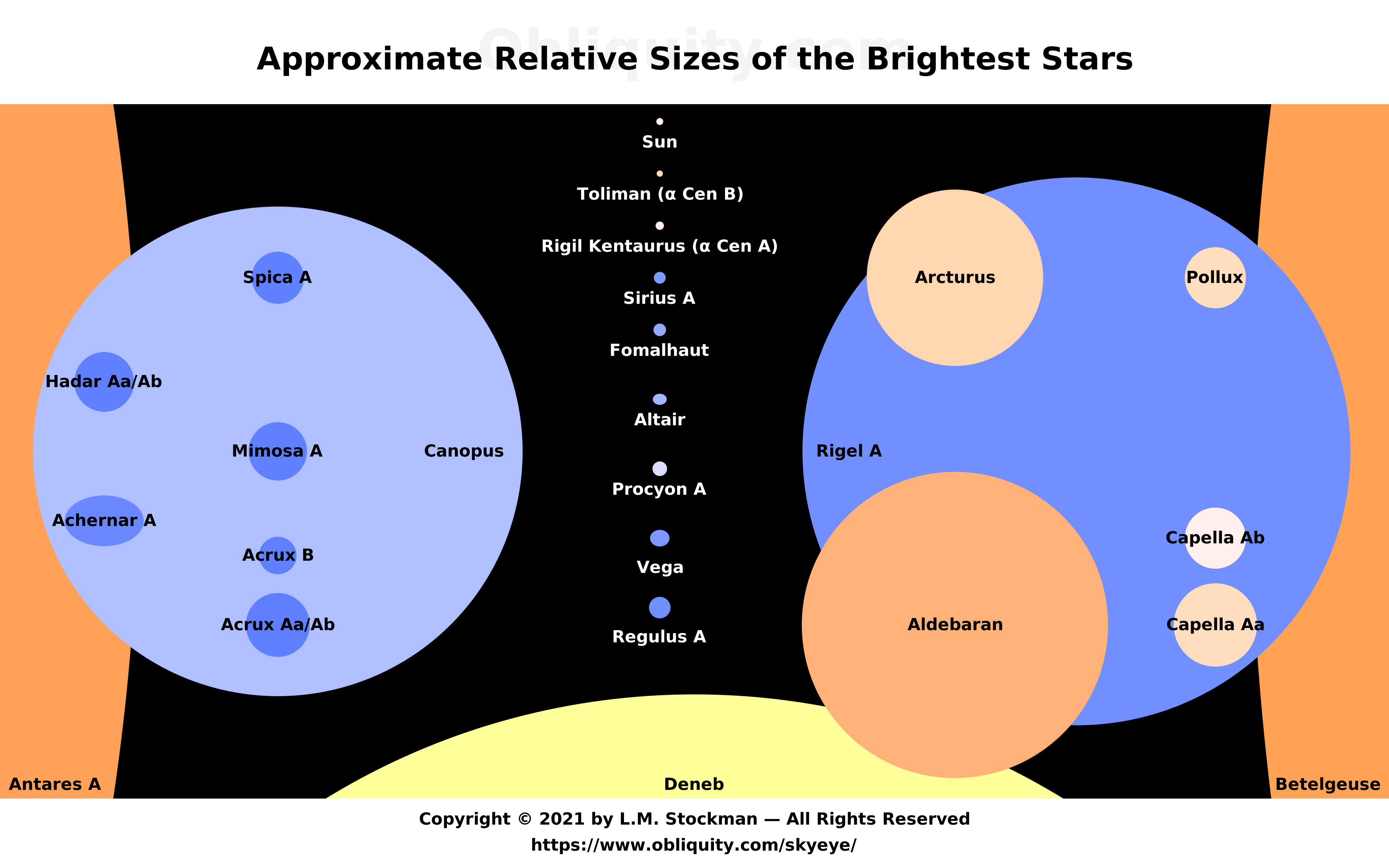
This chart lists the the brightest stars in the sky as seen from the Earth. Many of the stars are actually part of multiple systems whilst others have variable magnitude. The values for absolute magnitude and distance depend on the accuracy of the observations of the apparent magnitude and parallax. For this reason, the distances are given to three significant figures only. Some of the stars show a slight variability in brightness and are marked with an asterisk *. The Sun, which is the brightest star as seen from Earth, is provided for comparison.
| Name and Designation | Spectral Type | Magnitude | Parallax | Distance | |||
|---|---|---|---|---|---|---|---|
| Apparent | Absolute | (mas) | (pc) | (ly) | |||
| Sun | G2Ⅴ | −26.74 | +4.87 | ||||
| Sirius | α CMa A | A1Ⅴ | −1.46 | +1.45 | 379.21 | 2.64 | 8.61 |
| Canopus | α Car | A9Ⅱ | −0.74 | −5.62 | 10.55 | 94.8 | 309 |
| Arcturus | α Boo | K1.5Ⅲ | −0.05 | −0.32 | 88.50 | 11.3 | 36.9 |
| Rigil Kentaurus | α Cen A | G2Ⅴ | +0.01 | +4.34 | 754.81 | 1.32 | 4.31 |
| Vega * | α Lyr | A0Ⅴa | +0.03 | +0.60 | 130.23 | 7.68 | 25.1 |
| Capella * | α Aur | G3Ⅲ | +0.08 | −0.51 | 76.20 | 13.1 | 42.8 |
| Rigel * | β Ori | B8Ⅰae | +0.13 | −6.98 | 3.78 | 265 | 863 |
| Procyon | α CMi A | F5Ⅳ-Ⅴ | +0.37 | +2.68 | 284.56 | 3.51 | 11.5 |
| Betelgeuse * | α Ori | M1-M2Ⅰa-Ⅰab | +0.42 | −5.50 | 6.55 | 153 | 498 |
| Achernar * | α Eri | B6Ⅴpe | +0.46 | −2.69 | 23.39 | 42.8 | 139 |
| Hadar | β Cen | B1Ⅲ | +0.61 | −4.79 | 8.32 | 120 | 392 |
| Altair | α Aql | A7Ⅴn | +0.76 | +2.21 | 194.95 | 5.13 | 16.7 |
| Acrux | α Cru | B0.5Ⅳ | +0.76 | −4.21 | 10.13 | 99 | 322 |
| Aldebaran * | α Tau | K5+Ⅲ | +0.86 | −0.71 | 48.49 | 20.6 | 67.3 |
| Antares * | α Sco | M1.5Ⅰab-Ⅰb | +0.91 | −5.24 | 5.89 | 170 | 554 |
| Spica * | α Vir | B1Ⅴ | +0.97 | −3.45 | 13.06 | 76.6 | 250 |
| Pollux | β Gem | K0Ⅲb | +1.14 | +1.06 | 96.54 | 10.4 | 33.8 |
| Fomalhaut | α Psc | A4Ⅴ | +1.16 | +1.72 | 129.31 | 7.73 | 25.2 |
| Deneb * | α Cyg | A2Ⅰa | +1.25 | −6.93 | 2.31 | 433 | 1410 |
| Mimosa * | β Cru | B1Ⅳ | +1.25 | −3.41 | 11.71 | 85.4 | 279 |
| Toliman | α Cen B | K1Ⅴ | +1.33 | +5.70 | 754.81 | 1.32 | 4.31 |
| Regulus | α Leo | B8Ⅳn | +1.40 | −0.53 | 41.13 | 24.3 | 79.3 |

 Copyright © 1995–2023 by L.M. Stockman and David Harper